

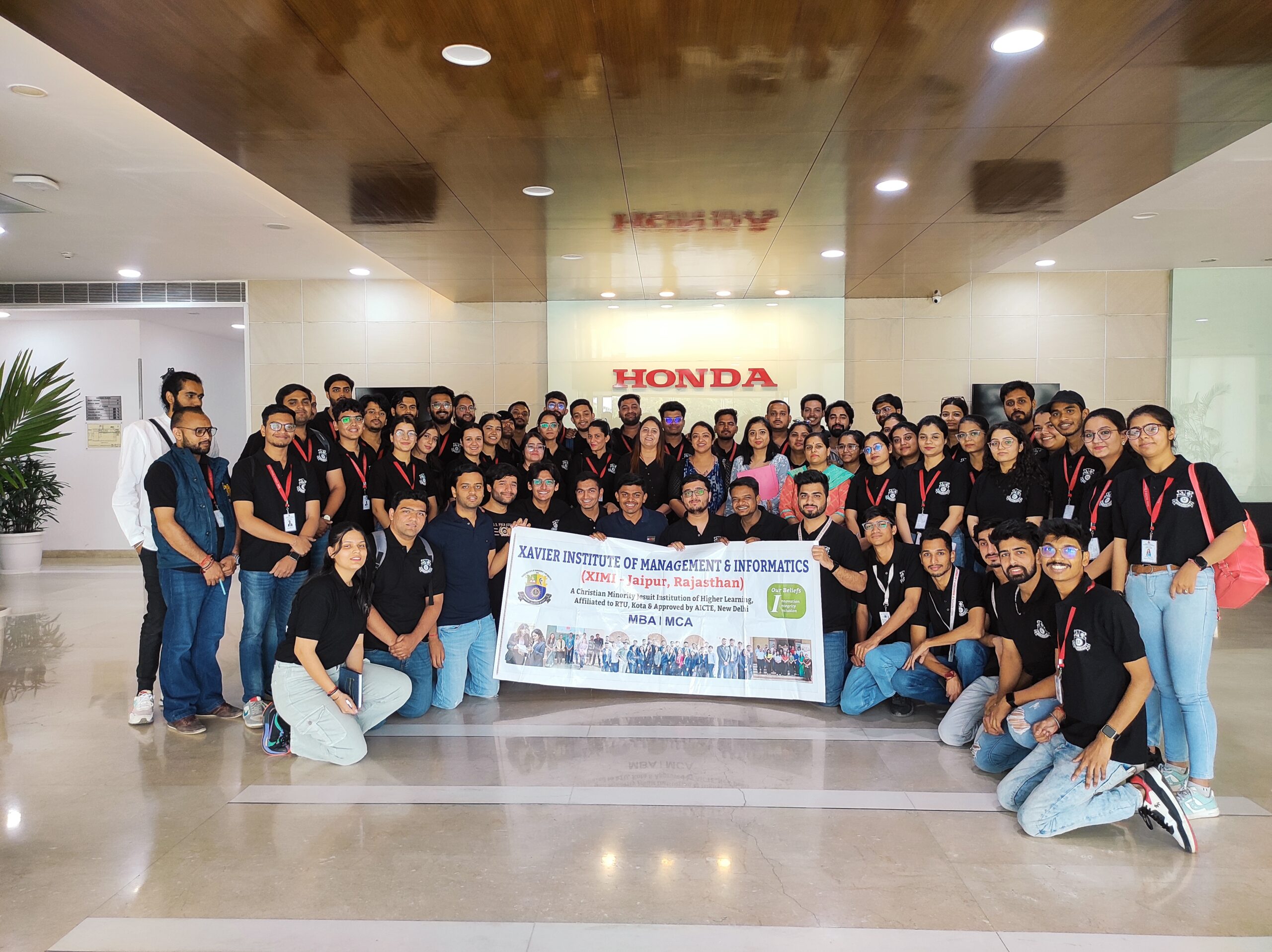
When students search for the top MBA college in Jaipur, they are usually looking for a straightforward answer. Which college has the best placements? Which college offers the highest salary package? Which college has the strongest reputation? Which MBA program will give them the best return on their investment?
These are reasonable questions. An MBA is a major investment of time, money, and effort, and students naturally want to make the right decision.
But there is another question that is often overlooked:
What actually makes an MBA college a good choice for your career?
The answer is not simply a ranking, a placement percentage, or the highest package advertised on a website. A strong MBA experience is created through a combination of academic learning, practical exposure, industry interaction, professional development, career support, and the opportunities students take advantage of during their two years.
This is particularly important today because the business world is changing rapidly. Artificial intelligence, automation, data analytics, digital transformation, changing customer behaviour, and new business models are influencing almost every industry. An MBA graduate entering the workplace needs more than theoretical knowledge. They need to understand how businesses work, how decisions are made, how teams operate, and how technology is changing the way organizations compete.
What Does “Top MBA College in Jaipur” Actually Mean?
The phrase “top MBA college in Jaipur” sounds like there should be one definitive answer.
In reality, there isn’t necessarily one college that is the perfect choice for every student.
A student interested in marketing may have completely different priorities from someone interested in finance. A future entrepreneur may look for a different environment from someone targeting a corporate management role. A student interested in business analytics may prioritize data-driven learning, while another student may be more interested in human resources or operations.
This means students should not blindly follow a ranking.
Instead, they should ask whether an MBA college matches their career goals.
A useful comparison should include the curriculum, specializations, practical learning opportunities, faculty, industry exposure, internships, placement preparation, professional development, fees, and overall learning environment.
The “top” college is ultimately the one that provides the right combination of opportunities for a particular student’s goals.
An MBA Should Teach You More Than Management Theory
There is a difference between studying management and learning how to manage.
A student can read about leadership in a textbook. But leading a team is a completely different experience.
A student can study marketing frameworks. But developing a strategy for an actual business problem requires another level of thinking.
A student can learn about finance. But making a decision when there are competing business priorities requires judgement.
This is why practical learning matters.
Case studies, presentations, group projects, business simulations, internships, workshops, industry interactions, and live projects can help students understand how management concepts work outside the classroom.
The purpose of these experiences isn’t simply to make an MBA more interesting.
They help students develop the ability to apply knowledge.
And that is what organizations ultimately need.
The Most Valuable MBA Skill May Not Be What You Expect
When people talk about MBA skills, they often mention marketing, finance, analytics, strategy, or operations.
But one of the most important skills is learning how to make decisions.
Business rarely provides perfect information.
A manager may have incomplete data.
A customer may suddenly change their behaviour.
A competitor may introduce a new product.
A project may fall behind schedule.
A team may disagree about the best approach.
There is rarely a textbook sitting on the desk with the exact answer.
An MBA should therefore help students become comfortable with ambiguity.
They need to learn how to analyze information, ask better questions, consider alternatives, communicate their reasoning, and make decisions.
That ability can remain valuable regardless of the industry they eventually enter.
Why Industry Exposure Matters
One of the questions students should ask when comparing the top MBA colleges in Jaipur is:
How much exposure will I get to the actual business world?
Industry interaction can take many forms.
Students may interact with professionals through guest lectures, workshops, internships, live projects, mentorship programs, business events, or placement activities.
These interactions help students understand what happens beyond the classroom.
They can also help students discover career options they may not have considered before.
A student might enter an MBA believing they want to work in marketing and discover an interest in analytics.
Someone interested in finance may become interested in fintech.
A student interested in HR may discover the growing role of people analytics.
Exposure creates possibilities.
Specialization Matters More Than Students Sometimes Realize
Choosing an MBA specialization is another important decision.
The specialization a student chooses can influence the subjects they study, the skills they develop, and the kinds of roles they explore.
St. Xavier’s College Jaipur Xavier Institute of Management and Informatics currently offers six MBA dual-specialization options:
- Marketing
- Finance
- Human Resource Management
- Business Analytics
- Information Technology
- Operations & Supply Chain Management
The dual-specialization model allows students to combine two areas rather than limiting themselves to a single management discipline.
This can be particularly relevant for students who want a broader understanding of business.
For example, someone interested in digital business might find the combination of Marketing and Information Technology interesting. A student interested in data-driven decision-making might explore Business Analytics alongside another business discipline.
The right combination depends on the student’s interests and career objectives.
Why Business Analytics and Technology Are Becoming Important in Management
Management education is no longer separate from technology.
A marketing manager needs to understand digital platforms and customer data.
A finance professional increasingly works with analytics.
HR teams use technology to understand recruitment and workforce trends.
Operations teams rely on automation, data, and digital systems.
This is why technology awareness is becoming increasingly important for management graduates.
An MBA student doesn’t necessarily need to become a software developer.
But understanding how technology influences business decisions can provide a significant advantage.
This is one reason programs that combine management education with areas such as business analytics and information technology can be particularly relevant in today’s business environment.
Placements Matter. But Look Beyond the Highest Package.
Let’s talk about the subject that most MBA aspirants care about.
Placements.
There is nothing wrong with considering placements. In fact, placement outcomes should be an important part of a student’s research.
But students should look beyond one impressive number.
Instead of asking only:
“What is the highest package?”
Ask:
“What does the overall placement ecosystem look like?”
Look at the types of companies participating, the kinds of roles offered, career preparation, internship opportunities, recruiter engagement, and the support students receive throughout the process.
XIMI Jaipur currently states that its MBA program provides 100% placement assistance, with 60+ recruiters listed on its official MBA page. The institute also highlights resume-building, mock interviews, industry mentorship, networking events, and regular placement drives.
Students should always verify the latest placement details, methodology, and applicable batch information directly with the institution before making a decision.
This is an important distinction.
Placement assistance is not the same thing as a guaranteed individual job outcome.
Students should evaluate the complete career-development process.
What Should Students Ask Before Choosing an MBA College?
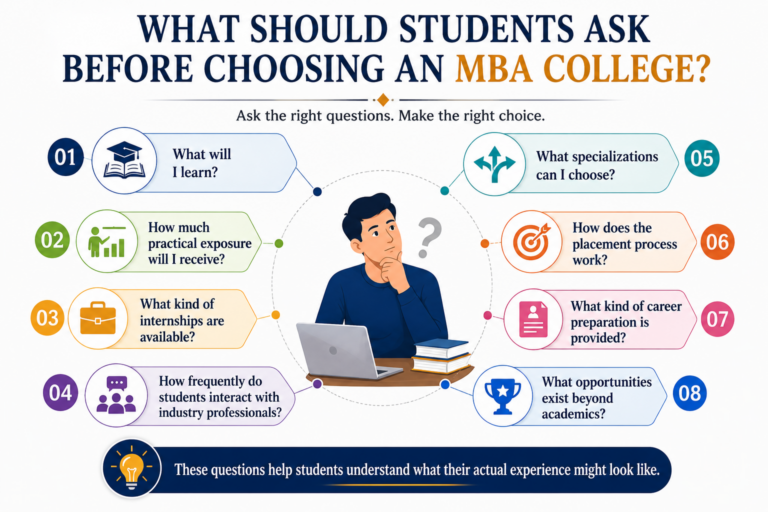
A college visit or admission discussion should involve more than asking about fees.
Students should ask meaningful questions about the program.
For example:
What will I learn?
How much practical exposure will I receive?
What kind of internships are available?
How frequently do students interact with industry professionals?
What specializations can I choose?
How does the placement process work?
What kind of career preparation is provided?
What opportunities exist beyond academics?
These questions help students understand what their actual experience might look like.
The Importance of Communication and Confidence
A technically knowledgeable student may still struggle during a job interview if they cannot communicate their ideas effectively.
An MBA is therefore also an opportunity to develop professional confidence.
Presentations, group discussions, team projects, interviews, case studies, and classroom participation can push students outside their comfort zones.
At first, speaking in front of a group can feel uncomfortable.
After doing it repeatedly, it becomes easier.
The same applies to interviews.
The more students practice explaining their ideas, defending their recommendations, and responding to questions, the more comfortable they become.
These skills can stay with them long after graduation.
An MBA Should Prepare Students for Change
The business world graduates enter in 2026 is not the same world that existed ten or twenty years ago.
AI is transforming business processes.
Automation is changing operations.
Data is influencing decisions.
Digital platforms are changing customer relationships.
Global competition is becoming increasingly connected.
This means MBA graduates need adaptability.
A successful management professional cannot depend entirely on what they learned during their degree.
They need to remain curious.
They need to keep learning.
They need to understand emerging trends.
And they need to be comfortable with change.
The best MBA education should therefore develop not just knowledge, but a learning mindset.
Why XIMI Jaipur Is Worth Considering
For students researching the top MBA colleges in Jaipur, Xavier Institute of Management & Informatics (XIMI Jaipur) is one institution worth exploring.
XIMI’s MBA is a two-year full-time program that is AICTE-approved and affiliated with Rajasthan Technical University, Kota. The current program offers six dual-specialization options and highlights industry-aligned learning, live case studies, expert faculty, modern learning facilities, internships, workshops, and mentorship.
The institute is part of St. Xavier’s College Jaipur and describes its MBA approach around developing industry-ready business leaders through academic learning, practical exposure, and industry engagement.
For prospective students, however, the most important thing is not simply reading these claims.
It is understanding how the program fits their own career goals.
Students should review the latest curriculum, fees, eligibility, admission process, specialization options, placement information, and other official details before making their final decision. XIMI’s current 2026–27 information lists the MBA program fee at ₹1,89,710 and provides details about eligibility, scholarships, specializations, and admissions.
Is an MBA Worth It in 2026?
For the right student, an MBA can be a valuable investment.
But the value of an MBA isn’t simply the degree itself.
It comes from what students do with the opportunities provided during the program.
A student who actively participates in projects, builds professional relationships, develops communication skills, gains internship experience, learns emerging technologies, and takes career preparation seriously can potentially gain much more from the MBA experience.
The degree provides the platform.
The student has to use it.
The Better Way to Choose a Top MBA College in Jaipur
Instead of searching for a college simply because someone calls it the “top MBA college in Jaipur,” students should create their own criteria.
Think about the professional you want to become.
If you want to become a marketing professional, examine the strength of marketing-related learning and practical exposure.
If finance interests you, explore the finance curriculum and opportunities.
If you’re interested in analytics, look at the role of data and technology within the program.
If you want to become an entrepreneur, look at the ecosystem around innovation and business development.
And if you are still unsure about your career direction, look for a program that gives you enough exposure to discover your strengths.
This approach makes the decision more personal.
And ultimately, education is personal.
The search for the top MBA college in Jaipur will probably always be driven by rankings, placements, fees, and reputation.
But those are only parts of the story.
The more important question is what happens between admission and graduation.
Does the student become more confident?
Do they learn to think strategically?
Can they solve business problems?
Can they communicate effectively?
Do they understand how technology is changing business?
Have they gained practical experience?
Have they built professional relationships?
Are they more prepared to enter the workplace?
These are the outcomes that can shape a career.
For students comparing MBA colleges in Jaipur, the right approach is therefore not to look for a single “best” answer.
Look for the right environment.
Look for a curriculum that is relevant.
Look for practical exposure.
Look for industry interaction.
Look for opportunities to develop.
Look for career preparation.
And most importantly, look for a college that aligns with the professional you want to become.
Because the real goal of an MBA is not simply to add three letters to your name.
It is to develop the knowledge, confidence, and capabilities to build a meaningful career.
Frequently Asked Questions
Which is the top MBA college in Jaipur?
There is no single definition of the top MBA college for every student. Students should compare curriculum, specializations, practical learning, industry exposure, faculty, internships, career support, placement outcomes, fees, and their own career goals.
Which MBA college is best for placements in Jaipur?
Students should compare verified placement information, recruiter participation, roles offered, internships, career preparation, and placement support rather than relying only on the highest package advertised.
What are the best MBA specializations in Jaipur?
Popular MBA areas include Marketing, Finance, Human Resources, Business Analytics, Information Technology, and Operations & Supply Chain Management. The best specialization depends on a student’s interests, strengths, and career goals.
Is an MBA worth doing in 2026?
An MBA can be valuable for students seeking management knowledge, career advancement, leadership skills, business exposure, and broader professional opportunities. Its value depends heavily on the quality of the program and how actively the student uses the available opportunities.
Why choose XIMI Jaipur for an MBA?
XIMI Jaipur offers a two-year, AICTE-approved MBA affiliated with Rajasthan Technical University, with six dual-specialization options and a focus on practical learning, industry exposure, professional development, and placement assistance.
What should I check before taking MBA admission in Jaipur?
Check eligibility, fees, curriculum, specialization options, faculty, practical learning, internships, industry exposure, placement methodology, career support, scholarships, and the overall learning environment before making a final decision.
Did you find this article helpful? OR Have any doubt, write in the comment section. To learn more about ximijaipur, check out the rest of our content, and visit our Pinterest site and follow us on Instagram.